


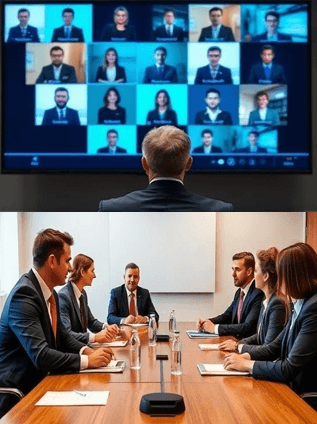
Online mediation has increased more and more, generally because it is an even quicker more convenient way of settling disputes. However, has it replaced in person, physical, face to mediations? Will it one day be the standard format for mediation, whereby in person mediation will become a thing of the past?
One would be hard pressed to say that online mediation has put an end to in-person mediation. In a sense it has become the norm in modern practice, opening up dispute resolution and broadening how it is done.
Yet there remains an occasion when the dynamics of negotiation, the emotions at play or the kind of dispute one is dealing with will make it more effective for mediators, lawyers and parties to come together in person. And or the parties, their lawyers and the mediator just prefer to mediate the dispute online or in person.
Read our full guide to online mediation in the UK.
Online Mediation Has A Parallel Format
A fairer assessment is to regard the online version as a robust parallel format and not a wholesale substitute. At its core mediation is about trust and persuasion, the art of managing human interaction and communicating. While these things can be found on screen as well as in the room, they are not the same some mediators argue. Technology is capable of replicating the mechanics of mediation: the long hours of bargaining, shuttle negotiation, private caucuses, document exchange and the like.
But it is argued that it does not always convey the quality of human presence. This is of consequence since logic and legal argument do not settle every matter. Sometimes it is because a mediator has read the room, or a party is made to feel heard, or anger and hesitation are put in their place by physical proximity.
Although there is stock in the above paragraph, a mediator can still mis read the room in person. I have heard of it happening. To be clear I have never done it. As an online mediator who now frequently mediates online, I would say a mediator can still read the room through a screen.
- I can tell when parties are engaging or not. When they are stalling.
- If their minds are wandering, not paying attention, playing with their phones etc.
- Body language, facial expressions, tone and pace has changed for the better or worse.
Online Mediation Is More Convenient?
Convenience and cost have been the chief drivers of the move to online mediation, as have altered expectations. The trend was given impetus by the spread of virtual hearings and remote work in commercial and legal circles. Especially in 2020 when lockdown occurred due to the pandemic.
Many have come to see that travel and the expense of a venue, not to mention the day lost in conference rooms, are unnecessary for a good number of disputes. It is argued that where claims are of lower value, or in insurance and workplace matters, or when participants are in different countries, it is very practical. Decision-makers who would not otherwise be free can be brought in from home or the office. Online mediation has in effect made in-person mediation more available.
Online Mediation Is Only Suitable For Some Cases?
However I would argue that I have mediated all types of disputes successfully through mediation online. And those that did not settle, would not have settled if we had in been in person. (Some would have created even more issues had we had been in person).
- Low value disputes ranging between £3,000 – £15,000.
- Medium-size disputes ranging between £15,000 – £50,000.
- Larger disputes ranging from £50,000 – £250,000.
- Substantial disputes ranging from £250,000 – £1 Million.
- Giant disputes ranging from £1 – £30 Million plus.
- These have ranged from boundary disputes (which all would assume need to be done on site), they do not! I was surprised myself how well online mediation services work well for boundary disputes. You can share, view and discuss the plans, view the alleged encroachment, view land registry documents, experts reports just as you could in person.
- All commercial matters, defamation, landlord and tenant, professional negligence, contract, TOLOTA, contentious probate (the list is endless and not exhaustive).
- To include every single type of workplace dispute you could imagine with just two employees to teams of employees. The most employees I have provided an online mediation service for was eighteen employees across four different teams based across three different locations. Birmingham, Kent and Manchester.
Accessibility is perhaps the principal advantage. For those with health or mobility problems, caring duties or a tight budget, remote participation is far less onerous. To be clear not all mediators charge less for an online mediation, that is a massive misconception, some do, a lot do not.
What used to mean time off work and accommodation can now be handled with a laptop and a decent connection, presenting an option to some who might have shied away from it. Geographically speaking, it spares cross-border disputants (those located at different sites, locations) the trouble of being assembled in one spot, leading to a greater readiness to settle and possibly at less cost.
Online Mediation Is More Efficient?
Then there is the matter of efficiency. With an online platform a mediator can put parties in and out of private rooms with little fuss, share papers and communicate by message. Lawyers need not vacate a room to have a word with their client and an expert, or insurer can be present for as long as is required. The day lends itself to a more flexible structure and in some instances, there is more momentum, people being less worn down by the logistics of it all. For a straightforward case where both sides are intent on risk assessment and numbers the virtual setting is enough.
Online Mediation Is Best For Simple Disputes?
However, again it could be argued the complexity of a case should not determine whether it should be conduced virtually or in person, face to face. As the types of disputes I have successfully mediated online have varied between the straightforward versus the extremely complicated. Two parties or employees versus several parties and employees, different jurisdictions, hundreds of thousands of pounds up to £35 million.
In certain sensitive or hostile disputes the emotional tone can be moderated by the medium. There is a psychological protection in being on screen instead of opposite someone at a table; it can make for calmer discourse and better listening, allowing engagement in circumstances that would be too confrontational face to face.
Again it could be argued, and I agree the exact opposite. Some disputes need to be in person, because doing them online would be too problematic and confrontational. For example where you get a telephone tough guy or keyboard warrior. Where they actually would be much more respectful, well behaved and sensible in person.
Online Mediators Can’t Match The In Person Touch?
But there are drawbacks to the service of online mediators which preclude it from entirely displacing the in-person approach. Physical presence is something of a casualty. Screens have a way of flattening communication and even with a camera running small gestures could go unremarked. Participants may seem more removed or distracted, and a mediator could be left with less to go on in determining if a party is ready to budge or if an intervention is called for. Mediation is no less dependent on the subtle energy of a room, body language and informal talk.
Technology can also get in the way. One can lose concentration over a few hours of mediation and find it waning faster online. There is the distraction of email or a phone call, or the knowledge that one is at an office desk or kitchen table and not in a neutral venue, which robs the proceedings of some of their gravity. And then there is the issue of a poor connection or an unfamiliar system breaking the flow.
Internet Connections Drop People Do Not
Thankfully in all the online mediations I have conducted only twice have there been connection issues, which were literally momentarily. And the connection issue was on the parties’ side, not mine.
I simply picked up the phone and called them and continued to discuss matters until the connection resumed. No it was not, or is not ideal, but is a valid workaround.
It is argued managing confidentiality and control is not as straightforward online. A mediator in the room can see who is there and put some order on the environment; on a screen one has to worry about recordings, interruptions, or a party being swayed by someone off camera. Safeguards may be in place, but the process does not have the same contained feel.
Online Mediation Can Be Secretly Recorded?
Nobody has recorded any of my mediations. If they did, it would be inadmissible in court, and they would find themselves in serious trouble from a judge. Because mediation is without prejudice and is confidential. Even in person someone could easily and secretly record the mediation or part of it. We are mediators not airport security staff. We do not have the authority or equipment to ensure participants are not secretly recording the mediation. It all conducted on trust and the assumption all knows the rules and will adhere to them.
Nothing Beats Physical Presence?
It is argued that an in-person mediation has powerful merits which make it an indispensable tool. The engagement is of a higher calibre. There is a focus that comes with physical presence. When parties have made the journey to a venue and put aside the day for a structured negotiation, they are more inclined to give themselves to the process. There may actually be some stock in this, but it could be argued the same for online mediation services.
The mediator is in a position to form rapport in a natural way, to read reactions with precision and make better use of silence and pacing. It is also where trust is most readily put in place, face to face, particularly if the dispute has its roots in a long-standing relationship or a failure of communication. All true to an extent, but this also works for online also.
It can also be argued that none of this can be achieved online or in person, where you have got hostile parties, who are full of mistrust and suspicion.
Where reputation, emotion or the need to maintain a relationship is at issue, in-person is of particular worth. It is argued that direct contact is what you really want and need in a family business dispute or an employee workplace conflict, community matters or when an apology is called for. A settlement may not be forthcoming on the numbers alone; sometimes the format is what permits a showing of frustration or the restoration of dignity, something possibly easier done in the same space.
In Person Mediation Makes People More Respectful
It is contended that there is also more discipline to a face-to-face negotiation. One cannot disengage so casually from a physical venue, and the mediator can set the rhythm of the day. Breaks and the odd corridor talk in the course of a real process can lead to a breakthrough unattainable online.
Very valid points, however parties in person can also be extremely obstructive and disengaging, refuse to answer simple questions, this is more a party, person issue, not whether this is more likely to happen through mediators online versus a physical one.
The very fact of having to be there is of assistance too; having put in the time and expense, parties are more driven to resolve things.
Yet there are drawbacks. In-person is generally costlier between the travel, room hire, catering and the like. More logistics means slower scheduling. Some will find it an intimidating environment to be in the same building as the opposition. With an international or a lower value dispute the effort involved can be disproportionate to what is at stake, and to demand face-to-face mediation in such instances is to risk making a settlement less likely and impede access to justice.
Conclusion
It would be wrong to see the two as competitors in a winner-takes-all fashion. They have their own functions. For civil or commercial disputes of modest value where speed and economy matter, online is arguably a better choice.
But then again, you have two parties fighting over a modest sum, to them it is not modest. It could be a whole months, or three to six months of their salary. So a face-to-face mediation would be better opposed to an online mediation UK.
But for the more complex human dynamics, where credibility is everything and emotions are running high, in-person is arguably (yet debatable) hard to beat. That is why the former has not and will not wholly supplant the latter. It is here to stay as part of dispute resolution, but it is not a panacea. A hybrid approach is more apt for the future: some cases online, some in person, some possibly a combination.
At the end of the day mediation is as much about the people in conflict as it is the exchange of offers. Technology is a fine aid to the process, but it does not have the force of presence or the kind of human insight that brings about a settlement. Online mediation is efficient and economical and will no doubt expand for those reasons. But there will always be a requirement for the face-to-face approach in many cases. Each has its strengths and its failings, and neither can do the job of the other.
Your mediator should also be able to tell, must tell you at the enquiry stage whether you should mediate online or in person. Even if you opted for one and they believe the other would be better. They of course should explain why. Contact Effective Dispute Solutions now. Take all the guess work out of it. Speak to an experienced mediator who will tell you exactly what you need to do and which medium to use and why it would be better for your particular dispute. Further reading on online mediation for MIAMS disputes at the Family Mediaiton Council.
Frequently Asked Questions
Has in-person mediation been made redundant by online mediation?
Not at all. While online mediation is an increasingly popular and effective way to go about things, it has not done away with in-person mediation. The merits of both are there; which is preferable will be dictated by the parties, the nature of the dispute and the negotiation dynamics.
Does online mediation hold up against face-to-face mediation in terms of effectiveness?
In many instances it does. For commercial or high-value claims, as well as property and workplace disputes, online mediation can be every bit as effective. More than the medium used, it is the disposition of the parties to put in the effort that counts.
What would one get out of online mediation?
For starters, there is the convenience and flexibility, and less time spent travelling. It is also more accessible and affords the opportunity to have on board insurers, experts or decision-makers from elsewhere.
What kind of disputes lend themselves to an online setting?
Quite a few. Online mediation is well suited to boundary and contract disputes, landlord/tenant issues, professional negligence, defamation, probate matters, workplace conflicts and commercial claims of any value.
Are there some cases where in-person is the way to go?
There are. If trust is lacking or emotions are high, or if the relationship is important, in-person mediation may be called for. Some parties are more inclined to act in a constructive manner in a formal face-to-face environment.
Will I save money with online mediation?
Not necessarily. You may see lower costs for venue, accommodation and travel, but mediators are not obliged to charge a lesser fee for an online session. The bottom line is a function of the case, the mediator and how the day is structured.
Is it possible for a mediator to pick up on body language and such over the internet?
To a great degree. An experienced mediator can judge engagement, tone and facial cues through a screen. Some will argue though that being in the room offers a level of insight that is otherwise unavailable.
How are technical difficulties handled?
The process is not easily derailed by minor problems. Should the connection fail, one can simply carry on by phone. A few brief interruptions are unlikely to stand in the way of a successful outcome.
Can I be sure of confidentiality and security?
As with in-person mediation, online mediation is confidential and without prejudice. Still, ground rules and trust are of importance given the potential for off-camera influence or unauthorised recording.
On what basis should I make my choice between the two?
Consider the claim’s value, the personalities at play, the logistics and whether a face-to-face meeting would further your prospects of a settlement. Your mediator will be able to put you in the right direction as to what will serve your case best.


One of the UK’s most experienced commercial and workplace mediators and mediation trainers. Mediating since 2002 across all sectors with over 2000 mediations conducted. Managing 39 mediators who in total have conducted over 6000 mediations.
Here to help you resolve your dispute quickly, cost effectively and without stress. As well as to answer all your questions about mediation.
Has mediated every single type of civil, commercial, employment, family business, probate, TOLATA, boundary, neighbour and workplace dispute. It is easier to say what he has not mediated, rather than what he has.
A Fellow of the Civil Mediation Council. A Law graduate, a CEDR, Academy of Experts & ADR Group Accredited Commercial Mediator. A Qualified Dispute Resolver, on RICS Neighbour Dispute Panel, a UK Mediation Accredited Workplace & Community Mediator. A Qualified Manager through the Chartered Management Institute – Level 5.
An associate Teacher and qualified Trainer, holding the Certificate in Teaching in the Lifelong Learning Sector – Level 4. Since 2007 he has been on the global mediation training faculty of the Chartered Institute of Arbitrators. Who he has delivered mediation training for, in the UK and overseas, on numerous occasions. Between 2018 and 2020, he was the Head of Mediation Training for the ADR Group. The oldest (1989) mediation training provider in the UK.